You Are Made of Energy: The Strange Truth About the Source of Mass
You Are Made of Energy: The Strange Truth About the Source of Mass
By Don Lincoln | Published: 2024-11-25 15:41:00 | Source: Hard Science – Big Think
Sign up for Big Think on Substack
The most surprising and impactful new stories delivered to your inbox every week for free.
If I ask you where your mass comes from, your answer might include an extra cake or two. However, if I asked a science enthusiast the same question, I would expect to hear that the true origin of mass is from a physical phenomenon called the Higgs field. While this claim is often seen in popular science stories, it turns out that it is not true at all. In fact, the Higgs field contributes very little to the mass of the universe. The reality is much more interesting.


First, let’s delve into why the science press claims that the Higgs field gives mass to objects.
Higgs field
The Higgs field was a theory that was created in the 1960s as a sort of band-aid to save another theory that was popular at the time. Physicists theorized that two well-known quantum forces — electromagnetism and the weak nuclear force — were actually manifestations of one fundamental force: the electroweak force. (Electromagnetism is responsible for electricity, magnetism, light, and much of chemistry, while the weak nuclear force is responsible for certain forms of radiation.)
In the same way that we know that ice and steam are just two different forms of water, these two apparently different forces were just two different ways of looking at the same thing. There was a problem with this new, unified force: it predicted that all subatomic particles had zero mass. This claim has been known to be false since the 1930s, so the electroweak theory may have died shortly after its birth. However, in the mid-1960s a group of physicists proposed an energy field – now called the Higgs field – that gave mass to some particles but not others.
Higgs field theory predicted the existence of a particle called the Higgs boson – often called the “divine particle” by some science journalists. The Higgs boson was discovered in 2012 by researchers working at CERN in Europe. With the discovery of the Higgs boson, the electroweak theory was validated.
It is true that the Higgs field gives mass to some subatomic particles, such as the familiar electron, as well as a class of particles called “quarks” found inside protons and neutrons. Because of this fact, reporters and science enthusiasts say that the Higgs field gives us mass.
What gives us mass?
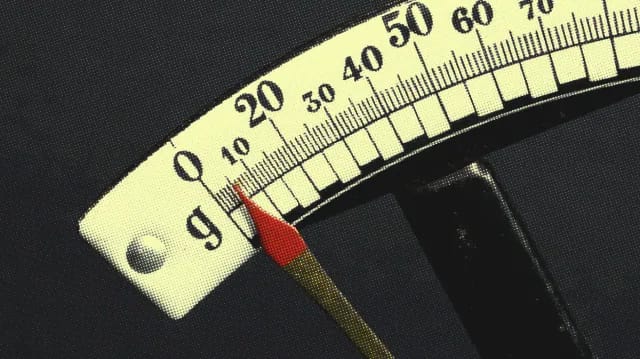
However, despite the success of the Higgs theory, this claim has been shown to be incorrect. We can illustrate this by asking where the mass of a 200-pound person comes from. If you ask a chemist, he will say that a person’s mass comes from the molecules of which he is composed. And if you weigh those molecules, you’ll find that they weigh 200 pounds.
Going deeper, we can ask: What is the mass of the atoms that make up these molecules? When you weigh them, you again find 200 lbs.
Within atoms there are protons and neutrons located at the center of the atom, as well as a cloud of electrons orbiting around the perimeter of the atom. Protons and neutrons weigh about the same, while electrons are lightweight, weighing about 0.05% of the mass of protons and neutrons. So, we can ignore electrons and focus on protons and neutrons. When you add their mass, you get 199.9 pounds (with 0.1 pounds in electrons).
To this point, a person’s mass appears to be contained in the subatomic particles of which they are composed; However, this is where the universe throws you a curve ball. Each proton and neutron contains three smaller particles called quarks. So, one would expect that if you added up the mass of the quarks, you would get the now boring number of 200 pounds.
But that’s not what you find. If you add up the mass of all the quarks in our 200-pound person, you find that the quarks weigh about 4 pounds.
So where do the other 196 pounds come from? This is where things get interesting. The answer is found, as is often the case, in Einstein’s famous equation E = mc2. This equation says that energy and mass are equal. How does this help?
It turns out that inside every proton and neutron, quarks are moving at very high speeds; In fact, these speeds can approach the speed of light. Very high speed means very high energy, and according to Einstein, very high energy means very high mass. However, there is more to the story.
Protons and neutrons are very small spheres, about a quadrillionth of a meter in diameter. If protons are made up of extremely fast quarks contained within such a small volume, there must be equally strong forces holding them together. Strong forces can also mean high energy, just like a very tight bow has more energy than a bow with a loose string.
You can add up the kinetic energy and containment energy of the quarks inside the protons and neutrons, and when you do that, you find that a person’s mass is not made of “stuff” in the way we normally think of it, but our mass is made of energy. In fact, all matter is made of energy. And in a (very loosely true) way, the pseudoscientific woo-woo crowd is right: we are all energy.
Now, one can go too far with pseudoscience claims, and this often happens. But the idea that our mass is nothing more than the frenetic movement of tiny subatomic particles, held together by unimaginable forces, gives us a completely different way of thinking about matter and energy. Once again, science has taught us that reality is much stranger than we imagine.
Sign up for Big Think on Substack
The most surprising and impactful new stories delivered to your inbox every week for free.
ــــــــــــــــــــــــــــــــــــــــــــــــــــــــــــــــــــــــــــــــــــــــــــــــــــــــــــــــ