
The Ultimate Playbook: Best Investment Strategies for Beginners in 2026

Ready to secure the bag? Discover the absolute best investment strategies for beginners in 2026. Learn about DCA, index funds, compound interest, and more.
Welcome to 2026. The world is moving fast, AI is literally everywhere, and the old-school advice of just stashing your cash under a mattress or in a basic checking account is looking more busted than ever. If you are reading this, you probably already know the vibe. You want to learn the actual investment strategies for beginners and start making your money work for you, instead of the other way around.
Let’s keep it 100: jumping into the financial markets can feel wildly intimidating. You see tech bros on social media bragging about their massive gains, and the next day you see headlines about the market crashing. It is enough to give anyone a serious case of FOMO mixed with absolute panic. But here is the secret that Wall Street doesn’t want to broadcast—building long-term wealth isn’t about getting lucky on a random meme coin or predicting the next Apple. It is about consistency, patience, and using proven strategies that actually work.

In this massive, no-fluff guide, we are going to break down everything you need to know. We will cover the core stock market basics, dive deep into strategies like dollar-cost averaging (DCA), and show you how to set up passive income streams that will totally change your financial trajectory. Grab your coffee (or energy drink of choice), get comfortable, and let’s get into it.
Why You Need to Start Investing Right Now (No Cap)
Before we dive into the “how,” we have to talk about the “why.” A lot of beginners think they can just save their way to wealth. But sitting on a pile of cash is actually a guaranteed way to lose purchasing power. Why? One word: Inflation.
Think about how much a burger combo cost five years ago compared to today. That difference is inflation silently eating away at the value of your dollar. If your money is just chilling in a standard bank account earning 0.01% interest, you are effectively taking a pay cut every single year.
Investing is your shield against inflation. But more than that, it is the vehicle you use to access the eighth wonder of the world: compound interest.
The Magic of Compound Interest
Compound interest is basically earning interest on your interest. It is the snowball effect in action. Let’s say you invest $200 a month into a solid index fund that averages an 8% annual return. You do this consistently for 30 years. You only put in $72,000 of your own cold hard cash. But thanks to the magic of compounding, your account would be worth over $290,000!


You can play around with the numbers yourself using the official Compound Interest Calculator from Investor.gov to see how crazy the math gets over time. The longer your money stays invested, the harder it works. That is why the best time to start investing was yesterday, and the second best time is today.
Step 1: Get Your Financial House in Order First
Hold up. Before you go throwing your whole paycheck into the stock market, we need to do a quick vibe check on your current finances. Investing is offense, but you need a solid defense first.
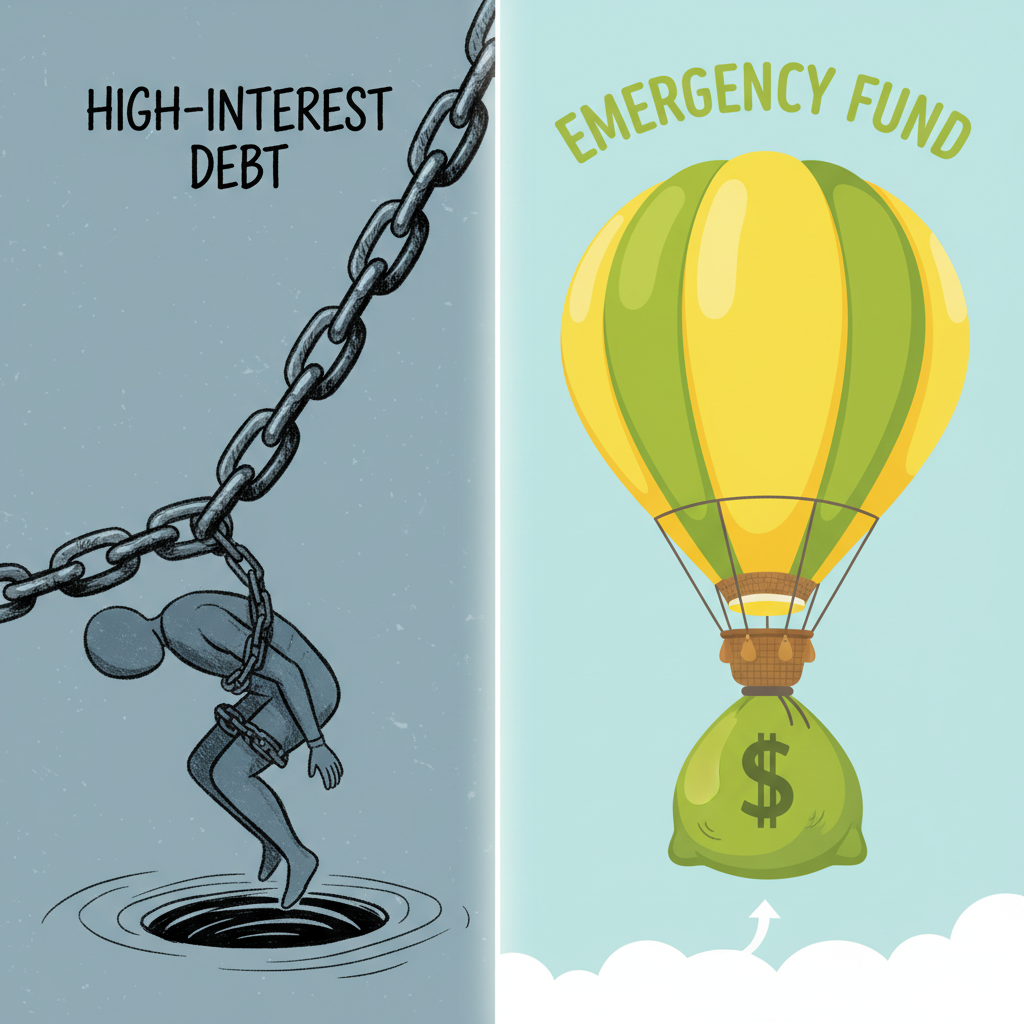
Build an Emergency Fund
Life happens. Cars break down, unexpected medical bills pop up, or maybe you suddenly lose your job. If you have all your money tied up in investments when an emergency hits, you might be forced to sell your stocks at a loss just to cover rent. That is a major L.
Aim to stash 3 to 6 months of living expenses in a High-Yield Savings Account (HYSA). This money isn’t there to make you rich; it is there to keep you out of debt when things go sideways.
Crush High-Interest Debt
If you have a credit card with a 24% interest rate, you are bleeding money. There is no investment strategy on earth that will reliably give you a 24% return year after year. Pay off those toxic debts before you start buying stocks. Once the high-interest debt is wiped out, you can redirect those monthly payments straight into your investment portfolio.
Step 2: Understand the Stock Market Basics
You don’t need a finance degree to understand the market, but you do need to know the players on the field. Let’s break down the basic asset classes you will be dealing with.
- Stocks: When you buy a stock, you are buying a tiny piece of ownership in a real company. If the company does well, your stock value goes up. If they fumble the bag, the value drops.
- Bonds: Think of a bond as an IOU. You are lending money to a company or the government, and in return, they promise to pay you back with interest over time. Bonds are generally safer than stocks but offer lower returns.
- Mutual Funds: A pool of money collected from many investors to invest in a massive portfolio of stocks and bonds, managed by a professional.
- ETFs (Exchange-Traded Funds): Similar to mutual funds, but they trade on the stock exchange like regular stocks. They are flexible, usually cheaper, and highly popular for beginners.
If you want a deeper dive into how the market actually functions behind the scenes, you definitely need to read The Ultimate Beginner Guide to the Stock Market in 2026 (No Cap). It breaks down the mechanics flawlessly.
Index Funds vs Mutual Funds: The Ultimate Showdown
One of the biggest debates in the investing world is index funds vs mutual funds. Which one deserves your hard-earned cash?
| Feature | Index Funds | Mutual Funds |
|---|---|---|
| Management Style | Passive (Tracks a set list of stocks, like the S&P 500) | Active (A human manager tries to pick winning stocks) |
| Fees (Expense Ratio) | Extremely Low (Usually under 0.10%) | High (Often 0.50% to 1.50%+) |
| The Goal | Match the market’s performance | Beat the market’s performance |
| Long-Term Track Record | Consistent and reliable over decades | Historically, the vast majority fail to beat the market long-term |
For most beginners, index funds are the undisputed heavyweight champions. Paying high fees for a mutual fund manager who probably won’t even beat the market is a total scam. Keep your fees low and let the market do the heavy lifting.
The Top Investment Strategies for Beginners in 2026
Alright, this is the main event. Here are the absolute best investment strategies for beginners. These aren’t get-rich-quick schemes; these are tried, tested, and proven methods to build massive wealth over time.
Strategy 1: The “Buy and Hold” Grind (Diamond Hands)
This is the simplest strategy on the planet, but weirdly enough, it is the hardest one for people to actually execute. The buy and hold strategy means exactly what it sounds like: you buy quality investments and you hold onto them for years, or even decades.
You completely ignore the daily news cycle. You ignore Jim Cramer yelling on TV. You ignore your coworker who claims the market is going to zero next week. You just hold.
Why does this work? Because historically, the stock market always goes up over long periods. There will be crashes, recessions, and global panics (we’ve seen enough of those lately). But the market recovers. If you panic sell during a dip, you lock in your losses. If you have “diamond hands” and hold through the turbulence, you ride the wave back up to new all-time highs.

Strategy 2: Dollar-Cost Averaging (DCA)
Trying to time the market—guessing when stocks are at their absolute lowest point to buy—is a fool’s errand. Even the pros get it wrong. Instead, you should use Dollar-cost averaging (DCA).
DCA is an investing strategy where you invest a fixed amount of money at regular intervals, regardless of what the stock market is doing.
For example, you decide to invest $100 every single Friday.
- If the market is up, your $100 buys fewer shares.
- If the market is down, your $100 buys more shares because they are “on sale.”
Over time, this smooths out the average price you pay per share and completely removes the emotional stress of trying to time the perfect entry point. You just set it on auto-pay and forget about it. It is the ultimate hands-off wealth-building hack.
Strategy 3: Index Funds and ETFs (The Cheat Code)
We touched on this earlier, but building a portfolio out of Index Funds and ETFs is basically an investing cheat code. Instead of trying to find the needle in the haystack (picking the one stock that will blow up), you just buy the whole haystack.
When you buy an S&P 500 ETF (like VOO or SPY), you are instantly buying a tiny piece of the 500 largest companies in the USA—Apple, Microsoft, Amazon, Nvidia, all of them. If one company goes bankrupt, it barely makes a dent in your portfolio because the other 499 companies hold you up.
ETFs are perfect for beginners because they provide instant diversification and are incredibly cheap to own. To master this specific approach, check out How to Invest in ETFs: The Ultimate 2026 Guide for Beginners. That guide will walk you through exactly which ticker symbols to look for and how to build a bulletproof portfolio.
Strategy 4: Dividend Investing for Passive Income
Imagine getting a notification on your phone that you just got paid, and you literally didn’t have to do any work for it. That is dividend investing.
Some established, profitable companies choose to give a portion of their earnings directly back to their shareholders. These cash payouts are called dividends. They are usually paid out every quarter.
As a beginner, you can focus on buying “Dividend Aristocrats”—companies that have a track record of paying and increasing their dividends for 25+ consecutive years. You can use these dividends as a source of passive income, or even better, automatically reinvest them back into the stock to buy more shares. This supercharges your compound interest machine.

Strategy 5: Maximizing Tax-Advantaged Retirement Accounts
Taxes can absolutely wreck your investment gains if you aren’t careful. That is why your investment strategy must include taking advantage of government-approved retirement accounts like the Roth IRA and the 401(k).
The 401(k) Employer Match:
If you have a 9-to-5 job and your employer offers a 401(k) match, you need to take it. If they say “we will match 100% of your contributions up to 5% of your salary,” that is literal free money. If you don’t contribute that 5%, you are leaving part of your compensation package on the table. Never say no to free money.
The Roth IRA:
A Roth IRA is arguably the greatest wealth-building tool available to the average person. You contribute money that you have already paid taxes on. Your money grows completely tax-free inside the account. When you hit retirement age (59.5), you can pull all that money out—including the massive gains—without paying a single dime in taxes to the IRS. It is completely legal, and it is incredibly powerful.
How Much Money Do You Actually Need to Start?
One of the biggest myths in the personal finance space is that you need thousands of dollars to start investing. That might have been true in the 1990s when brokers charged a hefty commission for every trade, but in 2026? It is absolutely false.
Thanks to fractional shares, you can buy a piece of a $500 stock for as little as $1. If you skip ordering DoorDash one time this week, you have enough capital to become an investor.
Starting small is actually a massive advantage. It allows you to learn the ropes, get comfortable with market fluctuations, and build the habit of investing without risking your entire life savings. If you are scraping the bottom of the barrel and want a realistic action plan, you absolutely must read How to Start Investing With $100 in 2026: The Ultimate Grind Guide. It proves that anyone can get in the game, regardless of their current bank balance.
Where to Invest: Picking the Right Platforms
Okay, so you have your strategy locked in. Now, where do you actually put your money? You need a brokerage account.
Today, the best investment platforms are totally free to use, charge zero commission fees on standard trades, and have slick mobile apps that make buying a stock as easy as sending a text.
If you want to be completely hands-off, you might want to look into robo-advisors. Platforms like Betterment or Wealthfront ask you a few questions about your age, risk tolerance, and goals, and then they automatically build and manage a perfectly diversified portfolio for you for a tiny fee.
If you prefer to buy your own ETFs and stocks, brokerages like Fidelity, Charles Schwab, and Vanguard are top-tier. Even modern finance apps like Robinhood or Webull are decent for beginners as long as you don’t get distracted by the flashy crypto and options trading features.
For a full breakdown of where to park your cash this year, head over to The Ultimate Guide to the Best Investment Apps in the USA (2026) 🚀 and pick the app that fits your personal vibe.

The Golden Rule: Diversification Strategy
If there is one phrase you need to tattoo on your brain, it is this: Don’t put all your eggs in one basket. This is the core of any legit diversification strategy.
Imagine you invest all your money into a single trendy tech company. If that company gets hit with a massive lawsuit or a new competitor crushes them, your entire net worth tanks. That is way too much risk.
Diversification means spreading your money out across different asset classes, different industries, and even different countries.
- Industry diversification: Owning tech, healthcare, energy, and consumer goods.
- Asset diversification: Owning stocks, some bonds, and maybe some real estate (like REITs).
- Geographic diversification: Owning US companies, but also European and emerging market companies.
By holding a widely diversified portfolio (which is super easy to do with ETFs), a disaster in one specific sector won’t blow up your financial future. Some assets will zigzag while others zag, giving you a much smoother ride upward.
Rookie Mistakes to Avoid Like the Plague
Look, we all make mistakes. But when it comes to your hard-earned cash, some fumbles are way too expensive to learn the hard way. Here are the most common beginner traps you need to dodge.
1. Panic Selling When the Market Drops
The market is going to have red days, red weeks, and even red years. It is completely normal. The worst thing you can do is log into your account, see that your portfolio is down 15%, and hit the “sell” button out of fear. When you do that, you turn a temporary paper loss into a permanent, real-life loss. When the market drops, remember that stocks are just on sale. Stick to your DCA strategy and keep buying.
2. Chasing Hype and Meme Stocks
We all saw what happened with GameStop and AMC a few years back. Sure, a handful of people made millions, but thousands of regular folks lost their life savings buying at the absolute peak. Investing is not a casino. If you are buying a stock just because it is trending on social media and you have FOMO, you are gambling, not investing. Stick to the fundamentals.
3. Ignoring the Impact of Fees
When you are picking funds, always check the Expense Ratio. Paying 1% a year in fees might not sound like much, but over 30 years, that 1% can eat up tens of thousands of dollars of your potential profits. Always hunt for low-cost index funds and ETFs.

4. Waiting for the “Perfect Time” to Invest
“I’ll start investing when the market crashes so I can buy at the bottom.” People have been saying this for decades, and while they sit in cash waiting for a crash, they miss out on years of massive gains. Time in the market always beats timing the market.
Frequently Asked Questions (FAQs)
How do I actually make money from stocks?
There are two main ways. First is Capital Appreciation—you buy a stock for $50, and years later, the company has grown, and the stock is now worth $150. You made $100 in profit. The second is Dividends—the company pays you a cut of their profits in cash on a regular basis just for holding the stock.
Are Robo-advisors worth it for a beginner?
Absolutely. If you find the stock market confusing or you just don’t have the time to research, robo-advisors are a massive W. They charge a very small fee (usually around 0.25%) to handle all the heavy lifting, rebalancing, and tax-loss harvesting. It is the ultimate “set it and forget it” tool.
Is investing in the stock market basically gambling?
No. Gambling is a zero-sum game based entirely on mathematical odds that are stacked against you by the house. Investing in the stock market is buying ownership in real businesses that create products, generate revenue, and grow the global economy. Over the long run, the stock market creates wealth; the casino drains it. For a deeper look at market integrity, you can read up on the regulations enforced by the U.S. Securities and Exchange Commission (SEC).
Should I invest while I have student loans?
This depends on the interest rate of your loans. If your student loans have a low interest rate (like 3% to 4%), it generally makes mathematical sense to make the minimum payments and invest your extra cash, because the stock market averages 7-10% long-term. But if you have private loans with nasty 10%+ interest rates, crush that debt first before you start heavily investing.
Wrapping It All Up
Let’s bring it home. Learning about the best investment strategies for beginners is only half the battle; the other half is actually pulling the trigger and taking action.
You now have the blueprint. You know that you need an emergency fund, you understand the power of compound interest, and you know that low-cost index funds, ETFs, and dollar-cost averaging are your best friends. You know that trying to time the market or chasing the latest hype stock is a quick way to get rekt.
Financial freedom isn’t reserved for people born with a silver spoon or folks working on Wall Street. It is entirely possible for you, starting today, even if you only have a hundred bucks to your name. Open that brokerage account, set up your first automated deposit, and let the magic of time and compounding take over. The grind starts now. Go secure the bag!
Thank you for being one of our most valued readers and for taking the time to read this article today!