
Debt Snowball vs Avalanche Method: Which Strategy Crushes It Best?
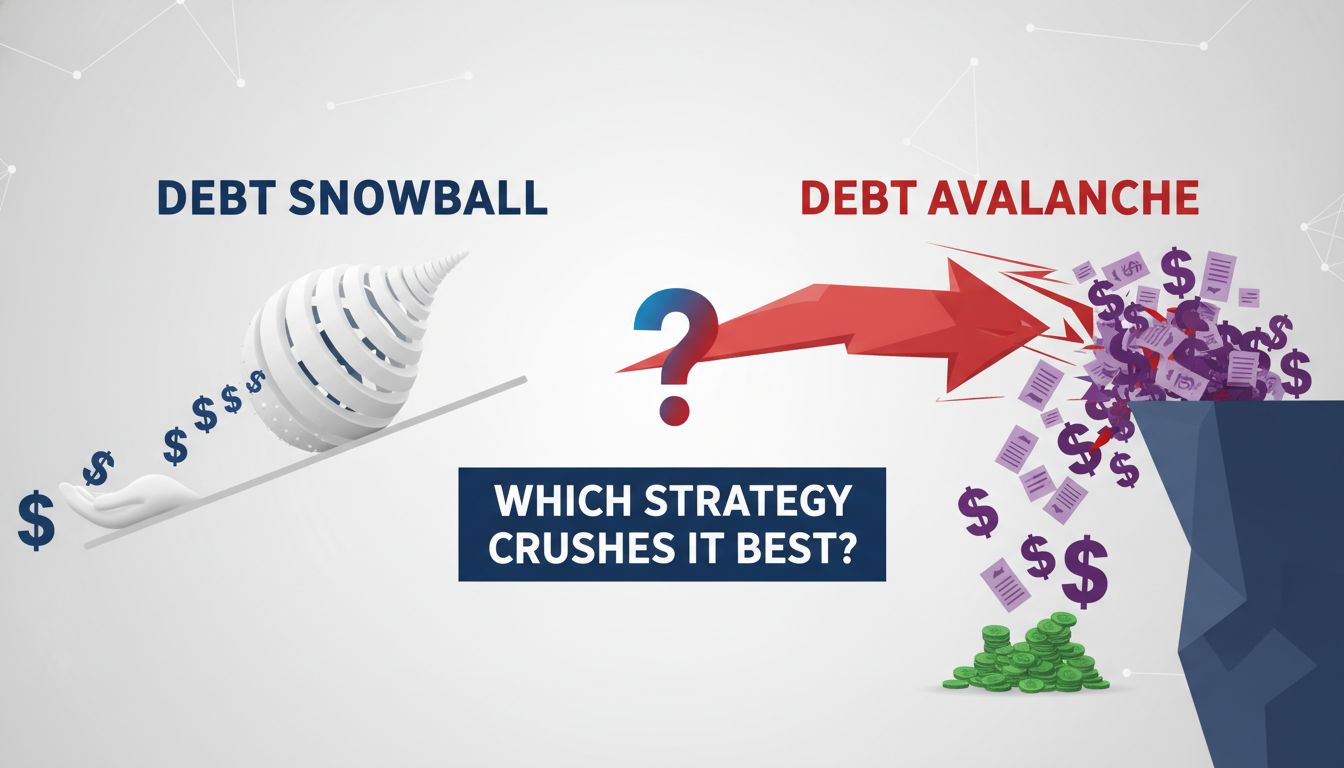
Debt snowball vs avalanche method
Let’s keep it 100 for a second. Opening up your banking app and seeing a mountain of debt staring back at you is honestly the quickest way to ruin your day. Whether it’s that credit card you maxed out during a weak moment, the student loans that feel like a lifetime sentence, or a car payment that’s eating up half your paycheck, debt feels like a heavy backpack you just can’t take off.
But here’s the good news: you don’t have to carry it forever.
If you’re ready to stop ghosting your bank statements and start taking back control of your money, you’ve probably come across two heavy-hitting strategies in the personal finance world. Yep, we’re talking about the debt snowball vs avalanche method.
These two approaches are basically the superstars of debt payoff plans. People argue about them on Reddit, financial gurus swear by one or the other, and honestly? Both of them have the power to completely change your life. But because you’re putting in the work to get your money right, you need to know which one actually fits your vibe, your brain, and your bank account.
So grab a coffee (made at home, obviously, because we’re budgeting ☕), and let’s spill the tea on the debt snowball vs avalanche method. By the end of this deep dive, you’ll know exactly which strategy to deploy so you can finally crush those balances and secure your financial bag.
The Real Talk: Why You Need a Strategy ASAP
Before we pit these two methods against each other, we have to talk about why just “winging it” doesn’t work.
When you have multiple debts, the natural instinct is to just pay the minimums on everything, maybe throw an extra twenty bucks at whatever bill annoys you the most that month, and hope for the best.
Spoiler alert: That’s a trap. 📉


Credit card companies and lenders absolutely love it when you only pay the minimums. Why? Because they make a massive profit off the interest you carry month after month. The longer you stay in debt, the more money they squeeze out of you. According to recent data from the Federal Reserve, the average credit card interest rate is sitting well over 20%. Let that sink in.
If you don’t have a calculated, aggressive strategy to pay down what you owe, you’re just throwing money into a black hole. You need a system that tells your money exactly where to go. That’s where our two contenders step into the ring.
Method 1: The Debt Snowball (Small Wins, Big Energy) ⛄
If you’ve ever listened to Dave Ramsey or scrolled through “Debt Free Community” posts on Instagram, you’ve definitely heard of the Debt Snowball.
This method is entirely based on human psychology. It completely ignores the math, the interest rates, and the logic of what saves you the most money. Instead, it focuses on one thing: Dopamine.
How the Debt Snowball Works
The premise is stupidly simple. You tackle your debts in order from the smallest balance to the largest balance, regardless of the interest rates.
Here’s the step-by-step breakdown of how you hustle this method:
- List it out: Write down every single debt you owe from the smallest total balance to the largest.
- Pay the minimums: You make the minimum monthly payment on every single debt on that list, except for the smallest one.
- Attack the smallest: You take every extra dollar you can find—from side hustles, selling old clothes, or skipping takeout—and throw it at that smallest debt until it is completely dead and gone.
- Roll it over (The Snowball): Once that smallest debt is paid off, you take the money you were using for it and roll it into the minimum payment for the next smallest debt on your list.
- Repeat: Keep doing this until you’re totally debt-free.
The Debt Snowball in Action
Let’s say you’ve got four debts. Here’s what your list looks like when ordered from smallest balance to largest:
- Target Credit Card: $400 (Minimum payment: $25)
- Medical Bill: $1,200 (Minimum payment: $50)
- Car Loan: $6,000 (Minimum payment: $150)
- Student Loan: $15,000 (Minimum payment: $200)
Total minimum payments = $425 a month.
Let’s assume you’ve tightened your belt and found an extra $200 a month in your budget to throw at your debt.
Month 1 & 2: You pay the minimums on the medical bill, car loan, and student loan. But for the Target card, you pay the $25 minimum plus your extra $200. That’s $225 a month going toward a $400 balance. Bam! In less than two months, that Target card is completely paid off.
Month 3: Now things get spicy. You take the $225 you were paying on the Target card, and you add it to the $50 minimum you were already paying on the Medical Bill. You are now throwing a massive $275 a month at the Medical Bill.
Month 7: The Medical Bill is gone. You take that $275 and add it to your $150 car payment. Suddenly, you’re blasting your car loan with $425 a month.
Do you see what’s happening? As each debt gets knocked out, the amount of cash you have to attack the next debt grows larger and larger. It literally snowballs.
Why the Snowball Method is a Vibe
Honestly, paying off debt is exhausting. It’s a marathon, not a sprint. The reason the Debt Snowball is so ridiculously popular is because it gives you quick wins early on.
When you see that first zero balance, your brain gets a massive hit of dopamine. You feel victorious. You start believing, “Wait, I can actually do this.” It builds momentum. For a lot of people, personal finance is 80% behavior and 20% head knowledge. If you lose motivation, you quit. The Snowball method ensures you don’t quit.
The Downside of the Snowball
The catch? You might end up paying more money in interest over the long run. Since you’re ignoring interest rates, a massive credit card balance with a 25% APR might be sitting at the bottom of your list, quietly racking up hundreds of dollars in interest charges while you focus on a 0% interest medical bill.
Method 2: The Debt Avalanche (The Math Nerd’s Dream) 🏔️
If the Debt Snowball is all about emotion and motivation, the Debt Avalanche is purely about cold, hard, calculated math.
For the hyper-logical folks who hate the idea of giving the bank a single extra penny, the Avalanche method is the ultimate flex. This strategy optimizes your money so that you pay the absolute bare minimum in interest over your payoff journey.
How the Debt Avalanche Works
Instead of looking at the total balances, you only care about the interest rates (APR).
Here’s how to set it up:
- List it out: Write down all your debts in order from the highest interest rate to the lowest interest rate. The actual balance size doesn’t matter at all.
- Pay the minimums: Just like the snowball, make sure every debt gets its minimum monthly payment so you don’t tank your credit score.
- Attack the highest rate: Take all your extra cash and throw it like a grenade at the debt with the highest interest rate.
- Roll it over: Once that bloodsucking high-interest debt is gone, take all the money you were putting toward it and attack the debt with the next highest interest rate.
- Repeat: Keep grinding until everything is at zero.

The Debt Avalanche in Action
Let’s take the same four debts from earlier, but this time, let’s look at their interest rates. Under the Avalanche method, your list gets totally rearranged:
- Target Credit Card: $400 (24% APR)
- Student Loan: $15,000 (6.8% APR)
- Car Loan: $6,000 (5% APR)
- Medical Bill: $1,200 (0% APR)
(Notice how the $15k student loan jumped to the #2 spot because of its rate, even though it’s the biggest balance!)
Let’s say you have the same extra $200 a month.
Luckily, in this specific example, the highest interest rate also happens to be the smallest balance (the Target card). So you pay that off in two months anyway.
But here’s where the paths diverge. Once the Target card is dead, you take that $225 and roll it into the Student Loan, because it has the next highest interest rate (6.8%).
You will be grinding on that $15,000 student loan for a long time before you get to cross it off. Meanwhile, that $1,200 medical bill is just sitting at the bottom of the list, getting only its $50 minimum payment every month.
Why the Avalanche Method is Elite
Math doesn’t lie. By attacking the highest interest rate first, you are stopping the bleeding where it hurts the most.
High-interest credit cards compound daily. By killing the highest rates first, you shorten the overall amount of time it takes to become debt-free (sometimes by several months), and you save yourself hundreds—sometimes thousands—of dollars in interest payments.
For a detailed breakdown on handling those brutal 25% APR cards, you definitely need to read How to Pay Off Credit Card Debt Fast in 2026. It’s the ultimate grind guide to getting those toxic balances out of your life.
The Downside of the Avalanche
Debt fatigue is real. If your highest-interest debt is a massive $20,000 personal loan, you might be throwing all your extra money at it for two straight years without ever getting the satisfaction of crossing an account off your list.
Without those early “quick wins,” a lot of people lose steam, get bored, and fall back into old spending habits. You have to have incredible discipline to stick to the avalanche.
Debt Snowball vs Avalanche Method: Head-to-Head Breakdown 🥊
Alright, let’s put these two heavyweights in the ring together. Which one actually wins?
Let’s judge them across three main categories:
1. Total Money Saved (Winner: Avalanche)
Because the Avalanche method specifically targets the debts that cost you the most to maintain, it mathematically saves you more money. If you run your numbers through a debt payoff calculator (like the ones offered by the Consumer Financial Protection Bureau), the Avalanche will almost always finish a few months faster and save you a chunk of change compared to the Snowball.
2. Mental Motivation (Winner: Snowball)
We are humans, not robots. If we functioned purely on logic, we wouldn’t be in debt in the first place, right? The psychological boost of paying off three small debts in six months is intoxicating. It makes you want to hustle harder. The Snowball wins the mental game, hands down.
3. Ease of Execution (Tie)
Both methods require the exact same mechanical steps: list your debts, pay minimums on everything, and throw all extra cash at target #1. They both require a budget, and they both require discipline.
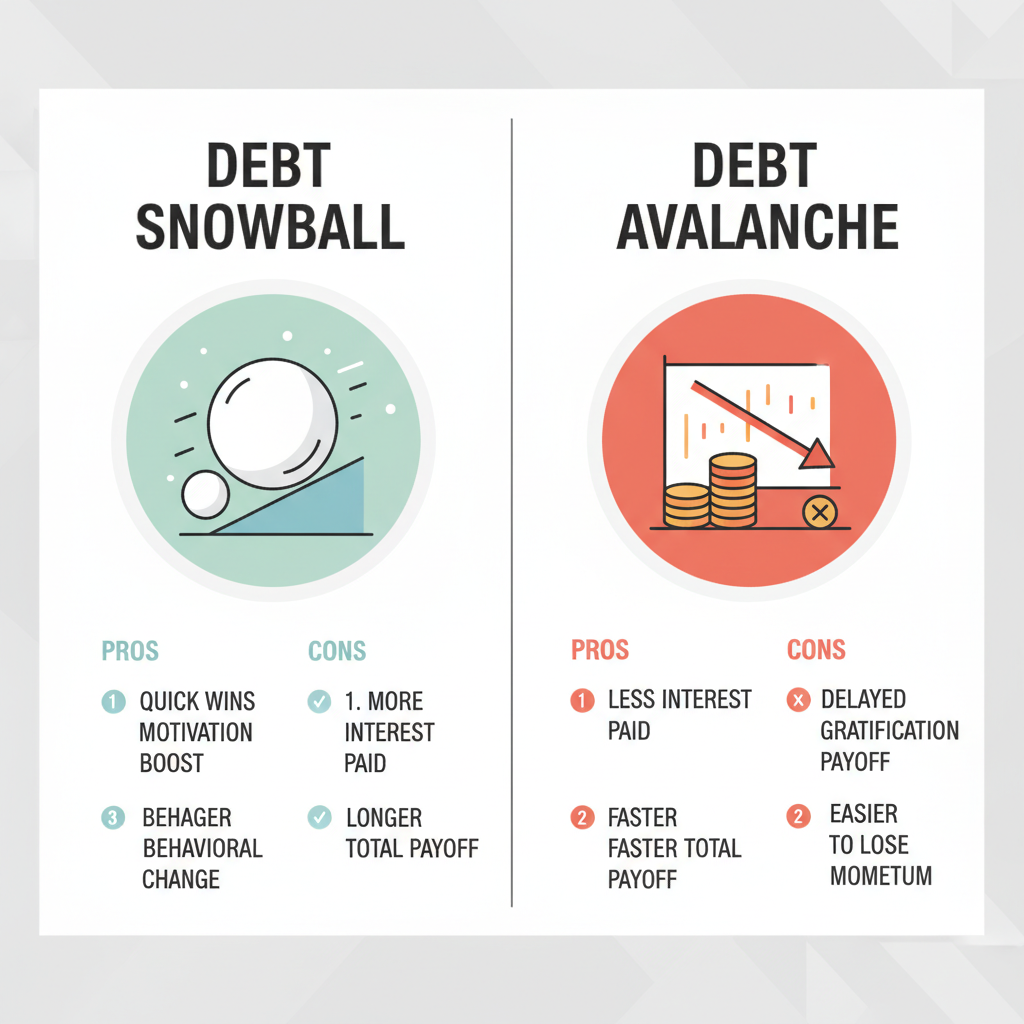
Setting Yourself Up for Success (The Pre-Game)
Here is a reality check: Neither the debt snowball vs avalanche method will work if you don’t have a solid foundation underneath you. You can’t out-strategize bad spending habits.
Before you pick your payoff method, you need to do two critical things.
Step 1: Lock Down a Budget
You cannot find “extra cash” to throw at your debt if you have no idea where your money is going. You need a zero-based budget. Every single dollar of your income needs an assignment before the month even begins.
If the word “budget” makes you want to take a nap, don’t stress. It’s actually a lot easier than you think. Check out How to Create a Monthly Budget for Beginners to learn how to build a realistic spending plan that doesn’t feel like a prison sentence.
Step 2: Free Up Cash Flow
The speed of your debt payoff depends entirely on how big your “snowball” or “avalanche” is. If you only have $10 extra a month, it’s going to take decades. You need to widen the gap between your income and your expenses.
You can do this by picking up a side hustle (Uber, freelance writing, walking dogs) or by ruthlessly cutting your current spending. Cancel subscriptions you forgot about, stop eating out four times a week, and negotiate your bills. For some quick wins on the expense side, dive into these 10 Easy Ways to Reduce Monthly Expenses and Save Big in 2026.
The Hybrid Approach: “The Debt Blizzard” ❄️
Can’t decide between the two? Why not mix them?
Some financial nerds call this the “Debt Blizzard.” Here’s how you finesse it:
Start with the Snowball method. Take your 1 or 2 smallest, most annoying debts and knock them out as fast as humanly possible. Get that dopamine hit. Do a little happy dance in your living room. Prove to yourself that you have the discipline to actually do this.
Once those pesky small balances are out of the way, pivot. Switch your strategy to the Avalanche method. Take that built-up momentum and aim it directly at your highest-interest debt to save yourself the big bucks.
This gives you the emotional victory early on, but transitions into the mathematically superior strategy for the long haul. It’s the best of both worlds.
Real-Life Hustle: Which One Fits Your Vibe?
Still on the fence? Let’s look at two hypothetical scenarios to help you choose your fighter.
Meet Sarah. (Team Snowball)
Sarah gets overwhelmed easily. Looking at her massive spreadsheet of 8 different student loans, 2 credit cards, and a medical bill gives her severe anxiety. She has tried paying off debt before but always quits after a month because she feels like she isn’t making a dent.
Sarah needs the Snowball. Paying off those two tiny $300 credit cards in the first two months will give her the mental clarity and motivation she desperately needs to tackle the bigger student loans later.
Meet Mike. (Team Avalanche)
Mike is a data analyst. He loves spreadsheets. When he sees that his travel credit card is charging him 27% APR, it physically makes his blood boil. He doesn’t care about “quick wins”; he just wants to stop the bank from robbing him blind. He is highly disciplined and can stick to a plan for years without needing a pat on the back.
Mike needs the Avalanche. He will happily attack his $10,000 credit card for 18 months straight knowing that he is saving $1,500 in interest charges.

Frequently Asked Questions (FAQs) 🤔
Can I switch methods halfway through?
Absolutely. It’s your money and your journey. If you start with the Avalanche and realize you are losing motivation because it’s taking too long to clear an account, pause. Re-rack your list from smallest to largest and switch to the Snowball for a bit. The only rule is that you keep paying extra toward the debt.
Should I consolidate my debt first?
Debt consolidation can be a solid move if you can secure a personal loan with a much lower interest rate than your current credit cards. It turns 5 payments into 1 payment. However, it’s a double-edged sword. If you consolidate your credit cards but don’t fix the spending habits that got you into debt, you’ll just end up maxing out the cards again while still having the new consolidation loan. Fix the behavior first!
Does Dave Ramsey ever recommend the Avalanche?
Nope. Dave Ramsey is a hardcore, uncompromising advocate for the Debt Snowball. He argues that if math were the solution, you wouldn’t be in debt. He strictly believes personal finance is a behavioral issue, which is why he only pushes the Snowball.
Should I stop investing while doing the Snowball or Avalanche?
This is hotly debated. Generally, if your employer offers a 401(k) match, you should contribute just enough to get the match (because that is literal free money). But beyond that, pause all extra investing until your high-interest, non-mortgage debt is wiped out. A 25% credit card interest rate will easily wipe out the 8-10% return you might get in the stock market.
Final Thoughts: Secure the Bag 💰
At the end of the day, when it comes to the debt snowball vs avalanche method, the absolute best strategy is the one you will actually stick to.
Debating the math vs. the psychology doesn’t matter if you aren’t actively making extra payments. Paralysis by analysis is real. Don’t spend six months researching spreadsheets while your accounts accrue more interest.
Pick a method today. Tonight.
List out your debts on a piece of paper. Figure out your minimum payments. Comb through your budget, cut out the fluff, and find that extra cash. Whether you want the quick dopamine hits of the Snowball or the mathematical efficiency of the Avalanche, you have the power to change your financial trajectory.
Stop letting debt dictate your life choices. Get aggressive, stay consistent, and go secure your financial freedom. You’ve got this! ✨
Your loyalty as a reader is something we never take for granted — thank you for visiting us today!