
10 Money Habits to Build Wealth in 2026 (How to Secure the Bag)
Want to secure the bag and achieve financial freedom? Discover the 10 realistic money habits to build wealth in 2026. Learn how to budget, invest, and grow your net worth.
Let’s keep it 100 for a second. If you’ve been scrolling through social media lately, you’ve probably seen a thousand “finance gurus” trying to sell you the dream. They stand in front of rented Lamborghinis, promising that if you just buy their $997 course, you’ll be a millionaire by next Tuesday.
Spoiler alert: that’s not how wealth works.
Real wealth isn’t loud, flashy, or built overnight. It’s built in the quiet moments. It’s built through boring, repetitive, and incredibly effective daily decisions. If you’re serious about your financial glow-up this year, you need to realize that personal finance is roughly 80% behavior and only 20% knowledge. You don’t need to be a math genius or a Wall Street insider.
What you actually need is discipline.

In fact, according to recent data, over 36% of modern millionaires started out with completely average, middle-class incomes. They didn’t win the lottery. They didn’t inherit a massive trust fund. They just played the game smarter than everyone else.
If you want to stop living paycheck to paycheck and finally take control of your financial destiny, you’re in the right place. Grab a coffee, take some notes, and let’s dive into the 10 money habits to build wealth in 2026.
Habit 1: Pay Yourself First (Automate the Bag) 🏦
The Reality Check
Most people handle their paychecks entirely backwards. The money hits their account on Friday morning. Immediately, the funds get scattered to the wind. Rent, car payments, utilities, subscriptions, weekend drinks, and takeout. Then, at the very end of the month, they look at their account balance and say, “Whatever is left, I’ll put into savings.”


Here’s the brutal truth: there is never anything left.
The 2026 Playbook
If you want to build wealth, you have to flip the script. You need to pay yourself first. This means the second your paycheck clears, a specific percentage gets automatically routed into your savings and investment accounts before you even have a chance to look at it.
When you automate your savings, you remove willpower from the equation entirely. You don’t have to “choose” to do the right thing every month because the system does it for you.
Action Steps:
- Set up split direct deposits: Ask your HR department to send 15% of your paycheck directly to a high-yield savings account (HYSA) or a brokerage account.
- Out of sight, out of mind: Keep your savings in a completely separate bank from your checking account. If you don’t see the money when you log in to pay for groceries, you won’t be tempted to spend it.
- Start small if you have to: Can’t do 15% right now? Start with 5%. The habit is way more important than the dollar amount when you’re just getting started.
Habit 2: Track Your Dollars Like a Hawk 🦅
The Reality Check
You can’t manage what you don’t measure. If you have no idea where your money is going, you will always feel broke, no matter how much your salary increases. A lot of people view budgeting as a financial straightjacket that stops them from having fun. But in reality? A budget is a permission slip to spend your money guilt-free on the things you actually care about.
The 2026 Playbook
You need a system. The most foolproof method for beginners is the 50/30/20 rule.
- 50% Needs: Housing, groceries, utilities, transportation, and minimum debt payments.
- 30% Wants: Dining out, hobbies, vacations, and that daily iced coffee.
- 20% Future You: Savings, investments, and aggressive debt payoff.
If trying to track every single penny in a spreadsheet sounds like a nightmare, let technology do the heavy lifting for you. There are incredible tools out there designed to automate this process. Dive into this guide on the Best Budgeting Apps in 2026: The Ultimate Guide for Beginners to find an app that syncs with your bank and categorizes your spending effortlessly.

Habit 3: Kill the “Lifestyle Creep” Vibe 🛑
The Reality Check
Imagine this: You finally get that promotion. You’re making an extra $1,000 a month. You should be getting ahead, right? But suddenly, your perfectly fine five-year-old car feels a bit “old.” Your apartment feels a bit small. You start upgrading your wardrobe, eating at pricier restaurants, and taking bigger vacations.
Before you know it, you’re making more money than ever, but you’re still living paycheck to paycheck. This is called lifestyle creep (or lifestyle inflation), and it is the absolute destroyer of wealth.
The 2026 Playbook
The wealthiest people I know don’t upgrade their lifestyle every time their income goes up. They upgrade their investments.
Action Steps:
- The 50% Rule for Raises: Whenever you get a raise or a bonus, commit to investing or saving at least 50% of the new money. You can use the other 50% to improve your lifestyle. This way, you get to enjoy your hard work, but your net worth still skyrockets.
- Embrace stealth wealth: Stop feeling the pressure to look successful to people you don’t even like. Your bank account doesn’t care about the badge on your car’s steering wheel.
Habit 4: Build a Bulletproof Emergency Fund 🛡️
The Reality Check
Life is going to throw curveballs at you. It’s not a matter of if, but when. Your car’s transmission will blow. The roof will leak. Your company might downsize. If you don’t have a cushion of cash ready to absorb these shocks, an inconvenience quickly turns into a full-blown financial crisis.
When people don’t have an emergency fund, they rely on credit cards. And once you start paying 25% interest on an emergency car repair, the wealth-building journey grinds to a devastating halt.
The 2026 Playbook
An emergency fund is your financial moat. It protects your investments and your peace of mind.
Action Steps:
- Target amount: Aim for 3 to 6 months’ worth of essential living expenses (rent, groceries, utilities, etc.).
- Where to put it: Do not keep this money in a traditional savings account earning 0.01% interest. Put it in a High-Yield Savings Account (HYSA). Let that money earn 4-5% while it sits there waiting for an emergency.
- Define an emergency: A flash sale on plane tickets to Tulum is not an emergency. Keep this money strictly for medical bills, job loss, or urgent repairs.

Habit 5: Invest Early and Often (Compound Interest Magic) 📈
The Reality Check
You cannot save your way to millions. Inflation will slowly eat away the purchasing power of your cash if you just leave it sitting under a mattress. To build real wealth, your money has to go to work for you. It needs to make babies, and then those babies need to make babies. That’s the magic of compound interest.
A massive mistake beginners make is waiting until they have a lot of money to start investing. They think, “I only have $50 a month to spare, what’s the point?”
The 2026 Playbook
The point is time. Time in the market is significantly more powerful than timing the market.
Let’s say you invest just $200 a month into a broad S&P 500 index fund starting at age 25. By the time you’re 65, assuming an average 8% return, you’ll have over $650,000. And you only contributed $96,000 out of pocket. That’s the power of compounding.
Action Steps:
- Take advantage of the match: If your employer offers a 401(k) match, contribute at least enough to get the full match. It is literally free money.
- Keep it simple: You don’t need to be picking individual stocks or day trading crypto. Stick to low-cost index funds and ETFs.
- Educate yourself: If you feel intimidated, don’t worry. Check out this comprehensive breakdown on The Ultimate Playbook: Best Investment Strategies for Beginners in 2026 to learn exactly how to get started.
Habit 6: Slay Bad Debt Before It Slays You ⚔️
The Reality Check
Not all debt is created equal. Debt can be a powerful tool to build wealth, but it can also be a massive chain around your neck.
Good debt is borrowing money at a low interest rate to buy an asset that appreciates in value or generates income (like a mortgage on a rental property or a strategic business loan).
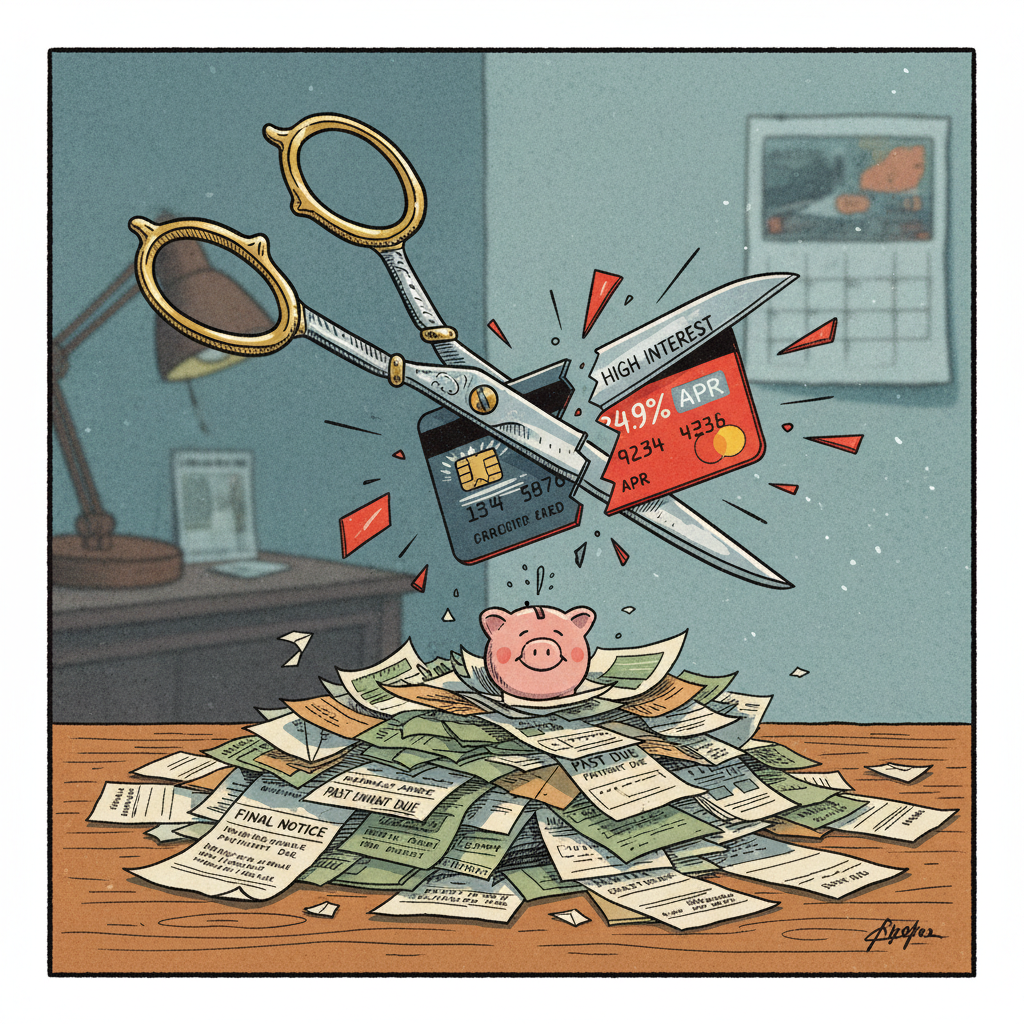
Bad debt is borrowing money at a high interest rate to buy depreciating liabilities (like putting designer clothes or a vacation on a credit card that charges 24% APR).
The 2026 Playbook
Paying off high-interest consumer debt is mathematically the best investment you can make. If you have a credit card with a 20% interest rate, paying it off is the exact same as getting a guaranteed, risk-free 20% return on your money.
Action Steps:
- Stop the bleeding: Stop using your credit cards completely until the balance is zero.
- Pick a strategy: Use the Avalanche method (paying off the highest interest rate first to save the most money) or the Snowball method (paying off the smallest balance first for a psychological quick win). Both work. Just pick one and attack it with everything you’ve got.
Habit 7: Create Multiple Income Streams (Side Hustle Energy) 🌊
The Reality Check
Relying on a single source of income is one of the riskiest things you can do in 2026. If you get laid off, your income drops from 100% to 0% in a single day. Studies frequently show that self-made millionaires rarely rely on just one paycheck; most have anywhere from three to seven streams of income.
Now, you don’t need to build seven businesses overnight. But you do need to start thinking outside the 9-to-5 box.
The 2026 Playbook
While cutting expenses is important, there is a floor to how much you can cut. There is absolutely no ceiling to how much you can earn. Increasing your income is the fastest way to accelerate your wealth-building journey.
Action Steps:
- Monetize your skills: Are you good at graphic design? Writing? Coding? Video editing? Offer freelance services online.
- Start a digital business: Create digital products, sell templates, or start content creation. The barrier to entry has never been lower.
- Explore your options: Need some inspiration? Read through the Best Side Hustles in 2026: The Ultimate Guide to Securing the Bag to find a gig that fits your schedule and skill set.
Habit 8: Upgrade Your Financial Literacy Daily 📚
The Reality Check
The school system failed us. We learned the Pythagorean theorem and the mitochondria is the powerhouse of the cell, but nobody taught us how to file taxes, read a balance sheet, or navigate a mortgage.
Because of this, a lot of people carry deep financial anxiety. They ignore their money because looking at it stresses them out. But ignorance isn’t bliss when it comes to money—ignorance is broke.
The 2026 Playbook
If you want to master the game of wealth, you need to study the rules. You should be dedicating a small portion of your week to upgrading your financial operating system.
Action Steps:
- Curate your feed: Unfollow influencers who just post luxury hauls and make you feel inadequate. Follow creators who talk about index funds, real estate, and budgeting.
- Read the classics: Grab a copy of The Psychology of Money by Morgan Housel or I Will Teach You to Be Rich by Ramit Sethi.
- Listen while you commute: Swap the true-crime podcast for a personal finance podcast twice a week.

Habit 9: Stop Trying to “Look” Rich (Quiet Wealth) 🤫
The Reality Check
We live in a hyper-visible society. Social media has trained us to constantly broadcast our lives to the world. Because of this, people spend money they don’t have, to buy things they don’t need, to impress people they don’t even like.
When you see someone driving a $100,000 car, the only thing you actually know about their wealth is that they have $100,000 less in the bank (or they are drowning in a massive monthly car payment). Designer logos and luxury flexes are usually signs of high income, not high wealth.
The 2026 Playbook
Real wealth is quiet. Wealth is what you don’t see. It’s the paid-off mortgage, the robust stock portfolio, the peace of mind, and the freedom to walk away from a toxic job without panicking.
Action Steps:
- The 48-Hour Rule: Whenever you get the urge to buy something non-essential, force yourself to wait 48 hours. If you still genuinely want it (and can afford it) after two days, buy it. But 90% of the time, the dopamine hit fades, and you realize you don’t actually need it.
- Value assets over applause: Choose assets that pay you while you sleep over liabilities that just make you look cool for a weekend.
Habit 10: Think in Decades, Not Weekends 🗓️
The Reality Check
We are wired for instant gratification. We want next-day shipping, fast food, and viral overnight success. But wealth building is a slow, methodical, and frankly, boring process.
People get frustrated when they don’t see massive results after investing for three months, so they pull their money out and blow it on a vacation. They let short-term desires sabotage their long-term freedom.
The 2026 Playbook
You need to stretch your time horizon. The decisions you make in your 20s and 30s will dictate whether your 40s and 50s are spent enjoying life or stressing over bills.
Action Steps:
- Set vivid long-term goals: Don’t just say, “I want to be rich.” Say, “I want a net worth of $1 million by age 45 so I can semi-retire and start a bakery.”
- Trust the process: Understand that the first $100k is a massive grind. But once compound interest takes the wheel, the growth becomes exponential. Stay patient. Stay disciplined.
Frequently Asked Questions (FAQs) 🤔
Can I really build wealth on a low or average income?
Absolutely. While making a six-figure salary certainly speeds up the process, it’s not a strict requirement. Your wealth is determined by the gap between your income and your expenses. By keeping your living expenses low, avoiding high-interest debt, and investing consistently, average earners can absolutely achieve millionaire status over a few decades.
How much of my income should I be saving each month?
A fantastic baseline goal is 20%, which aligns with the 50/30/20 rule. However, if that feels impossible right now, don’t use it as an excuse to save nothing. Start with 1%, 3%, or 5%. The goal is to build the habit of saving. As your income grows, increase the percentage.
Is it too late to start investing if I’m in my 30s or 40s?
It is never too late. While you may have missed out on a decade of compound interest, the best time to plant a tree was 20 years ago; the second best time is today. You might need to save a slightly higher percentage of your income to catch up, but aggressively attacking your investments now will drastically improve your retirement years.
Should I pay off debt or invest first?
It depends on the interest rate of your debt. If you have credit card debt with an interest rate of 15-25%, pay that off immediately before investing. No safe investment will consistently beat a 25% return. However, if your debt is a low-interest mortgage or a student loan sitting around 3-4%, you’re generally better off paying the minimums on those while investing your extra cash in the market.
The Final Word on Securing the Bag 🎒
Building wealth in 2026 isn’t some mythical secret reserved for trust fund kids and tech billionaires. It’s a formula. It requires discipline, patience, and a willingness to step off the hamster wheel of mindless consumerism.
You don’t have to implement all 10 of these money habits by tomorrow morning. Pick one. Start by setting up an automatic transfer to your savings account. Or start tracking your expenses this week. Or read one personal finance book this month.
Small, positive financial behaviors stack up over time. If you stay consistent, avoid bad debt, and keep stacking assets, your future self is going to be incredibly grateful. Now get out there and secure the bag! ✨
We are thrilled that you chose to read this article — your support and loyalty are truly remarkable!